by Mark Hudson | Sep 4, 2015 | Draft and Flow
Unpleasant odors coming from the fireplace can, unfortunately, be common problems in the summer due to draft and flow chimney issues. Although fireplace odor issues can be the result of creosote accumulations or birds or animals living inside the chimney, quite often the bad smell is simply old smoky air from the chimney. According to the Chimney Safety Institute of America (CSIA), the air flow in your house is constantly moving, even though you cannot see it. Most often, air tries to flow out through the upper parts of your home, and air flows into the house through its lower part to try to replace the air that left. To better understand draft and flow, Hudson Chimney would like to tell you more about some of the things that influence the actual flow of air into and out of your home.
WIND-LOADING
The effect on interior house pressures caused by the wind, wind-loading takes place when wind hits your home and creates high pressure on the side it hits and low pressure on the downwind side. If you open windows or doors on the windward side, this will help both to pressurize the house and increase the chimney draft. On the other hand, if you have your windows or doors on the downwind side opened, this can depressurize the house and allow the smoky air from the chimney to enter your home by backdrafting.
INTERIOR MECHANICAL DEVICES
Clothes dryers, kitchen, attic, and bathroom fans, and central vacuum systems can remove large volumes of air and cause depressurization that leads to backdrafting. This often results in negative pressure around your fireplace, stove, or other heating appliance. Forced-air furnaces also take a large amount of air away from a home. When these systems have leaky ducts, it can negatively affect draft by causing air to be blown into the attic or crawlspace.
WEATHERIZATION
When you get your house weatherized to keep cooled air in during the summer and heated air in during the winter, you can possibly seal your home off too tightly to the point where air cannot flow properly. This leads to the stack effect, which is where warm air rises to the highest level and creates a pressurized area. The stack effect can be behind several chimney draft issues.
Noticing signs of chimney draft problems this summer? Contact us at Hudson Chimney to find out how we can help you solve these issues.
by Mark Hudson | Aug 20, 2015 | Chimney Crown Info
Just as you would think from the name, chimney crowns sit at the very top of masonry chimneys to prevent water and animals from getting inside the chimneys. A crucial part of a masonry chimney system, your chimney crown needs to be in good condition to best protect your chimney. If your crown is suffering from hairline cracks, your chimney could be in danger of even more cracking and spalling damage. Luckily for the residents of the Jacksonville, FL area, Hudson Chimney specializes in repairing and building chimney crowns. We would like to tell you more about this important part of your masonry chimney by sharing with you some information from the Chimney Safety Institute of America (CSIA) about chimney crowns.
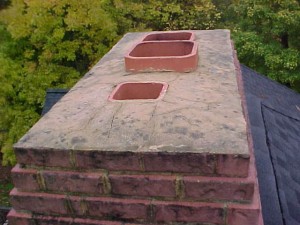
What exactly does a chimney crown do?
Covering the top of the chimney to seal it from the flue liner to the chimney edge, a chimney crown constructed by Hudson Chimney provides a downward slope to direct water from the flue to the edge of the crown. Without a chimney crown, the entrance to your chimney is wide open and can easily be invaded by water from rain and melted snow and animals such as birds, raccoons, and squirrels. Both water and animals will do a lot of potentially expensive damage to your masonry chimney, which is why it is so important to have a properly built chimney crown on the top of your chimney.
What kind of damage can water and animals do to my chimney?
The CSIA calls water the biggest enemy of masonry chimneys because it erodes away bricks and mortar. Hudson Chimney often sees spalling damage, which is caused when water that has penetrated masonry materials freezes within those materials, it expands. As the water thaws out, it forces the bricks and mortar to crack and break apart. If this type of damage is left untreated, the structure of your chimney is in jeopardy as it could collapse. The greatest type of damage done by animals has more to do with the nesting materials they leave behind in your chimney. Abandoned animal nests in a chimney create dangerous hazards such as fires ignited from the materials and debris and flue blockages that can cause poisonous gases like carbon monoxide to be forced back into your home.
What are the details of a properly built chimney crown?
Constructed from a Portland cement-based mixture, a proper chimney crown should be installed so that it provides an overhang projecting beyond all sides of the chimney by a minimum of two inches. Hudson Chimney additionally ensures that the flue liner tile projects above the crown also by a minimum of two inches.
Concerned about your chimney crown? Contact Hudson Chimney to inspect the condition of your crown and make recommendations for repairs or a rebuild. You can trust us to protect the inside of your chimney with a correctly constructed and installed chimney crown.
by Mark Hudson | Aug 3, 2015 | Chimney Video Inspection
Whenever your chimney is inspected by one of our Chimney Safety Institute of America (CSIA)-certified chimney sweeps from Hudson Chimney, you will be able to see exactly what we saw, thanks to video scans from the Chim-Scan Closed Circuit Internal Evaluation System. A video scan inspection can be extremely valuable, especially if damage is found to your chimney during the inspection. Our sweeps benefit from these video scans as well as they are able to see every inch of the inside of your chimney when they use this camera technology. We would like to answer some of the most frequently asked questions we have encountered about Chim-Scan video inspections.
What exactly is the Chim-Scan Closed Circuit Internal Evaluation System?
Explained by the company that creates and manufactures this system, a Chim-Scan is a remote imaging video camera that has been specifically engineered to be moved up and down inside a chimney. This provides both our chimney sweep and the homeowner a video scan of each inch of the interior walls of a chimney. When this Chim-Scan system is used, everyone can see an up-close view of parts of your chimney that are extremely difficult to see by regular means.
What makes a video scan important in a chimney inspection?
Required by the National Fire Protection Association (NFPA) in their Level 2 and Level 3 chimney inspections, video scans are so important to Hudson Chimney that we also use them in our basic Level 1 inspections. One of the main reasons why we feel this way is the ability of the Chim-Scan camera to spy every inch of your chimney’s interior. This allows us to spot hazardous damage that we could have missed seeing if we did not use this tool. You could have damage to the inside of your chimney that needs to be repaired before you can safely use your fireplace. An example of this damage are cracks that could allow the poisonous gases created by combustion to enter your home. Also, if you need to report any damage to your home insurance agent, a video scan can give you the evidence your agent will need to file a claim.
What are the other advantages of video scan inspections?
Along with discovering hard-to-see damage, a video scan inspection can also be used to determine details about damage from a chimney fire, uncover improper repair work, and find animals and/or their nests within a chimney. A crucial part of a chimney fire investigation, a video scan can help diagnose the cause of the fire and the amount of any damage which happened in the fire. You will also be provided with written reports, photographs, and/or video recordings after a video scan inspection.
Discover the value of a video scan inspection. Contact Hudson Chimney today to schedule your annual chimney sweeping and inspection.
by Mark Hudson | Jul 23, 2015 | Chimney Sweeping Before Fall
Although it may seem far away, the month of September will be here before you realize it. Did you realize that many national fire safety groups like the National Fire Protection Association (NFPA) and the Chimney Safety Institute of America (CSIA) recommend that you have your chimney professionally swept and inspected before lighting the first fire of the year? The reason behind this recommendation is to be sure that your fireplace and chimney system works properly and safely so that you will not experience any hazardous problems during the winter. September begins the busiest time of the year at Hudson Chimney for our CSIA-certified chimney sweeps. Their schedule will be packed full through December cleaning chimneys across the Jacksonville area, and scheduling an appointment during these months can be difficult. You may have to wait several weeks to be able to arrange your annual chimney sweeping on the date and time you need. We suggest to our customers to go ahead and schedule this important chimney maintenance task in the late summer before fall arrives to be able to get the appointment at a time that is convenient. To let you know what you can expect from a cleaning from our chimney sweeps, we would like to tell you more about this service.
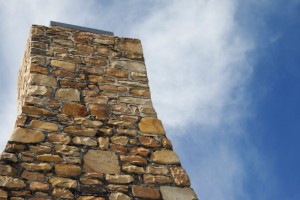
Hudson Chimney takes care to keep your home clean as we sweep your chimney.
Our CSIA-certified chimney sweeps begin the sweeping process by covering the area surrounding your fireplace with tarps to protect your home from soot, dust, and other debris. A high-speed vacuum cleaner will also be set up over your fireplace opening to keep dirt from entering your house.
Hudson Chimney sweeps your chimney clean from its top to its bottom.
Our sweeps will use hand brushes as well as brushes on rods to scrub the walls of your chimney clean from the floor of the firebox all the way up to the top of the flue. Your damper will also be cleaned, inspected, and adjusted. Our chimney sweeps will focus on removing all of the accumulated creosote deposits to prevent a dangerous and possibly devastating chimney fire. Creosote is a natural compound which is the residue of the byproducts of combustion of a wood-burning fire and can be extremely flammable. You will be able to safely light fires without any worries of creosote deposits causing problems after your chimney has been swept by Hudson Chimney.
Hudson Chimney performs a professional chimney inspection as part of the sweeping process.
To ensure your chimney is free from hazardous blockages and has no damage, our chimney sweeps will use a close-circuit video camera to get a close look at the interior of your chimney. The exterior of your chimney will also be inspected, and our certified sweeps will pay close attention to the condition of your bricks and mortar. After the sweeping and inspection has been completed, our sweeps will provide a written document of their findings, and they will be sure to explain everything to you so you understand the condition of your chimney.
Don’t wait until the fall to schedule your chimney sweeping. Contact Hudson Chimney today to make an appointment for this essential annual chimney maintenance service.
by Mark Hudson | Jul 10, 2015 | Chimney Draft Issues
Since your chimney is a venting system, draft issues can affect the performance of your fireplace and chimney. Draft problems can cause different outcomes, and repairing a draft issue depends on what is causing the problem. At Hudson Chimney, we often get calls from customers who are unsure if and how draft could be affecting their chimneys. We thought we would share some information from Mother Earth News about how to tell if you have a drafty chimney and how to identify what is causing the problem.
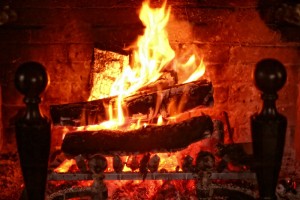
You have a hard time lighting a fire.
If you cannot seem to get a good fire burning in your fireplace, there is a good chance your chimney is too cold. Cold temperatures have an effect on chimney draft. If you feel cold air coming from your fireplace, you may need to prime the flue before starting a fire. Simply light a rolled-up newspaper and hold the flame as high as you can into your chimney until you can feel the draft reverse.
Smoke blows into your house from the fireplace.
Sometimes, this problem can be solved simply by repairing the damper to ensure it fully opens to allow smoke to properly exit out of the chimney. However, other things can lead to smoky fireplaces, including cold chimneys. The size of your flue can also cause draft issues that lead to smoke blowing into your home through the fireplace. If you only notice a smoky fireplace on windy days, you may need a new chimney cap to keep wind patterns from reducing the chimney flow. You can contact Hudson Chimney to take care of these problems that are causing draft issues for your chimney.
You notice unpleasant odors coming into your home from your fireplace.
If your home is noticeably smoky smelling and you are not burning a fire in your fireplace, negative air pressure is most likely the reason for the odor entering your house through the fireplace from the chimney. Many times when people weatherize their homes to heat and cool more efficiently, they can seal up windows and doors too tightly. This creates the need for more air to be brought into the home through the fireplace, and this air brings along the smoky smells of the chimney. An easy way to combat negative air pressure is to slightly open up a window to allow more air to enter the house.
Are you dealing with any of these chimney draft issues? Contact Hudson Chimney to schedule a consultation with our Chimney Safety Institute of America (CSIA)-certified chimney sweeps to professionally diagnose and solve this problem for you. We work hard to keep your fireplace and chimney working safely and properly.